
Why Tax Residency Triggers KYC Reviews
EXPAT BANKING
Blog > Expat Banking > Why Tax Residency Triggers KYC Reviews
Why Tax Residency Triggers KYC Reviews
EXPAT BANKING
BANKEAZ | Expats Team
7/20/2026 - 4 min read
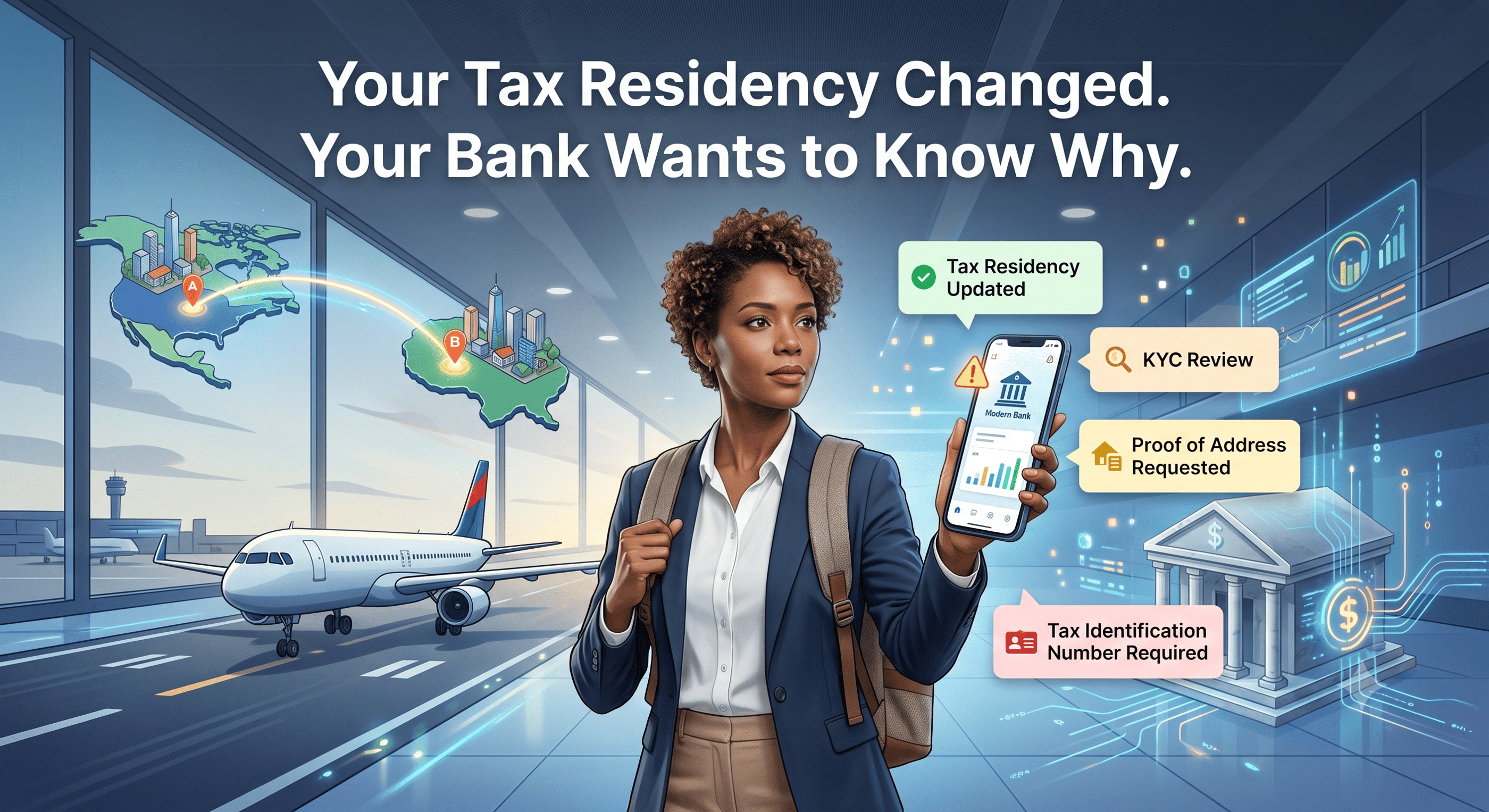
Changing tax residency can make a normal bank account suddenly look risky.
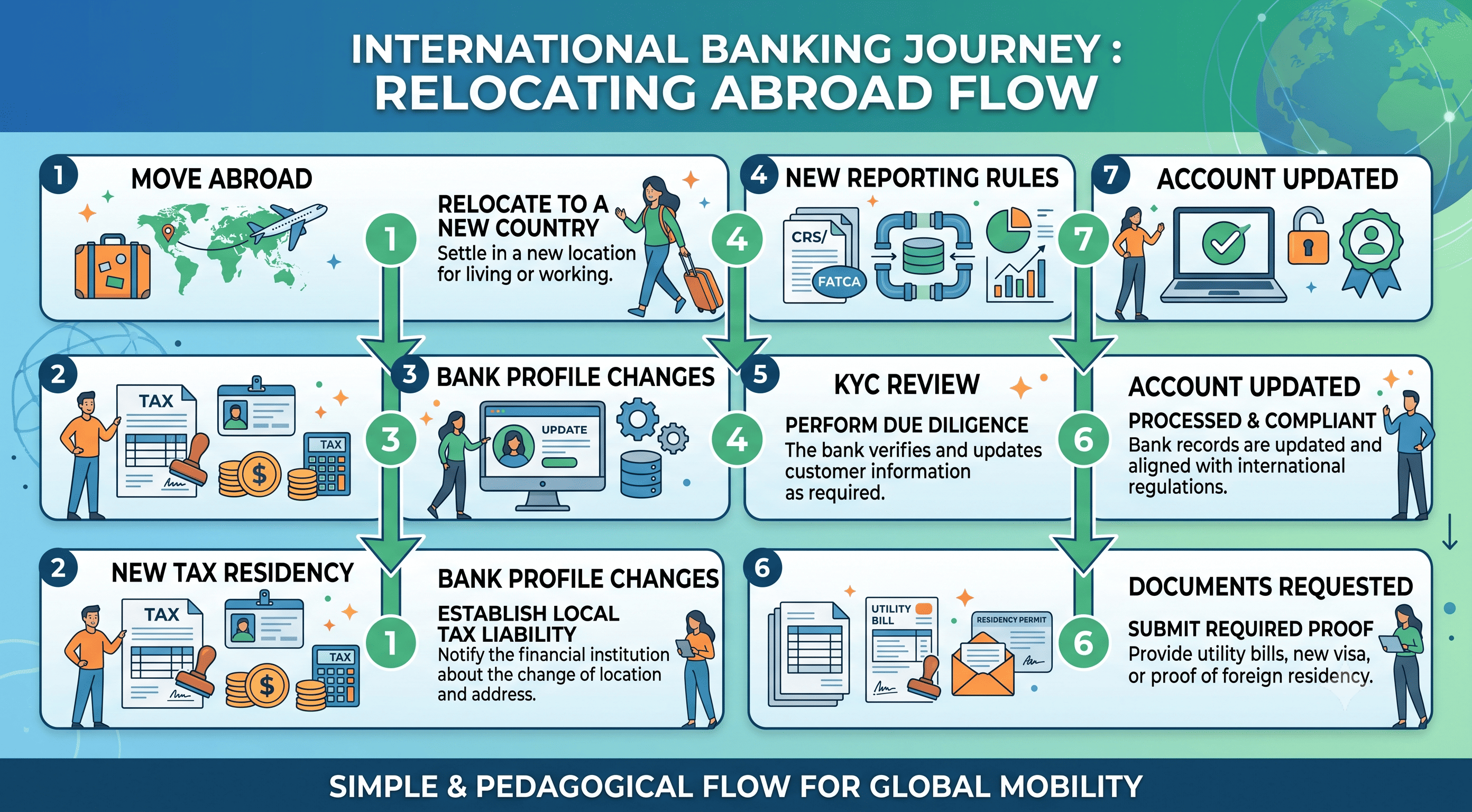
The issue is not always your income, your balance, or your spending. It is the fact that your banking profile no longer matches the country information your bank has on file. When your tax residency changes, banks may need to review your KYC, address, tax identification number, source of funds, and account activity.
This affects expats, remote workers, international students, founders, and people living between countries. A simple move abroad can turn into a banking review because financial institutions must understand where customers are tax resident and whether account information should be reported.
For people using expat banking or international banking, the problem is practical. Payments may be delayed. Documents may be requested again. Account features may be limited until the bank is satisfied.
You live internationally. Your bank should too.
Manage your money across countries without hidden fees, delays, or complexity.
Simplify your financial life abroad with Bankeaz.
Banking built for life between countries
Free early access
> Why does tax residency matter to banks?
Tax residency tells a bank where you may owe tax and which country's reporting rules may apply to your financial account.
That makes it different from a mailing address. You may live in one country, receive income from another, and remain connected to a third. For a bank, that combination can require extra checks.
According to the OECD ↗, the Common Reporting Standard sets out the financial account information to be exchanged, the financial institutions required to report, the taxpayers covered, and the due diligence procedures financial institutions must follow.
This is why a tax residency change can trigger bank verification. The bank may need to confirm whether your old information still applies or whether your account now falls under a different reporting obligation.
For globally mobile customers, this is one of the hidden frictions of international banking.
> What can trigger a banking review?
A review can start when the bank detects a mismatch between your profile and your activity.
Common triggers include:
A new foreign address
A new tax identification number (TIN)
Salary from another country
Regular transfers between countries
A change in visa or residence status
Use of the account from a new location
Outdated documents on file
None of these automatically mean something is wrong. But they can make the bank ask questions.
A customer may have moved from France to Germany, kept a French account, started receiving income from a UK employer, and added a German tax number. To the customer, this is normal expat life. To the bank, it is a changed risk and reporting profile.
Moving country changes more than your address. It changes how your bank reads your financial identity.
> Why do banks ask for documents again?
Banks ask for documents again because your previous file may no longer describe your current situation.
You may already have verified your passport, address, and income. But if your tax residency changes, the bank may need updated proof of address, a new tax identification number, or confirmation of where your income comes from.
This is a common account verification problem for people using banking for expats. The customer feels already known. The bank sees a profile that has changed.
The review may involve:
Identity documents
Proof of residence
Tax residency declaration
Tax identification number
Employment or income evidence
Source-of-funds information
The difficulty is not only collecting documents. It is collecting documents that match the bank's accepted formats, languages, dates, and country rules.
> How can a tax residency review affect your money?
A tax residency review can affect access, timing, and financial control.
Some customers experience delayed transfers because the bank pauses activity while checking the account. Others may face temporary limits on payments, card usage, or international transfers. In more serious cases, the bank may restrict or close the account if it cannot support the customer's new country profile.
The practical consequences can be frustrating:
Rent payments may be delayed
Salary access may be interrupted
Family support transfers may be blocked
Direct debits may fail
Business payments may require extra explanation
This is where cross-border banking becomes personal. A compliance review is not just a form. It can decide whether money moves when you need it.
For mobile people, financial access depends on whether banks can understand movement without treating it as suspicious.
> Why is this harder for expats and mobile workers?
Expats and mobile workers often have financial lives that do not fit one-country banking systems.
They may keep accounts in their home country, open accounts abroad, send money to family, receive income internationally, and move again within a few years. Their profile is not unstable. It is international.
Traditional banking systems, however, often treat mobility as an exception. A changed tax residency may sit beside a foreign phone number, a new address, and cross-border payments. Each detail may be legitimate. Together, they can create friction.
This is why financial mobility needs better banking infrastructure. People do not stop being financially reliable when they move. But banks often need clearer, reusable ways to understand international customers.
______________________________________________________________________________________________________________________________________________________
> How could banking reviews change in the future?
Banking reviews may become less repetitive if financial systems improve how they handle international identity.
Future progress could come from reusable identity verification, better digital tax residency declarations, interoperable banking data, and clearer cross-border compliance processes. Instead of asking customers to restart verification every time they move, banks could rely on trusted, updated information that travels with the customer.
This does not mean compliance will disappear. Banks will still need to understand customers, detect risk, and follow reporting rules.
But the experience could become more practical. A mobile customer should not have to rebuild their financial identity from zero every time life crosses a border.
The future of banking abroad is not only faster apps. It is banking that understands movement.
You moved countries.
Your financial life shouldn't have to start from zero
International Transfers
> Conclusion
Tax residency changes can trigger banking reviews because they change how a bank understands your identity, reporting status, and financial activity.
For expats and globally mobile people, this can mean repeated documents, delayed payments, restricted access, or uncertainty at exactly the moment financial continuity matters most.
The future will depend on whether banks can move from country-by-country profiles to portable financial identity. Until then, one lesson matters:
A bank account may look stable, but the rules behind it move when you do.
______________________________________________________________________________________________________________________________________________________
by BANKEAZ
On demand banking services for all


______________________________________________________________________________________________________________________________________________________
Learn more about Expat Banking

Global lives deserve simpler banking.






Download the BANKEAZ app for a 100% mobile banking experience. Available on iOS and Android - public testing by invitation.
Bankeaz is designed for people living between countries. Availability may vary depending on the user’s jurisdiction of residence.
The Bankeaz app is developed by Arcadia, a company currently being incorporated in Switzerland.
Bankeaz does not provide banking services in its own name. Financial services are provided by licensed and regulated partner institutions, in accordance with applicable laws and regulations.
Copyright © 2026 - Arcadia | Bankeaz - All rights reserved
Address
____________________






__________________________________________________________________________________________________________________________________________________


(- - -) - - - - - - - - - -
Zurich - CH
__________________________________________________________________________________________________________________________________________________
___________________________________________________________________________________________________________________________________________________
__________________________________________________________________________________________________________________________________________________
Learn
____________________