
Why Name Formats Break International Banking
EXPAT BANKING
Blog > Expat Banking > Why Name Formats Break International Banking
Why Name Formats Break International Banking
EXPAT BANKING
BANKEAZ | Expats Team
7/27/2026 - 4 min read
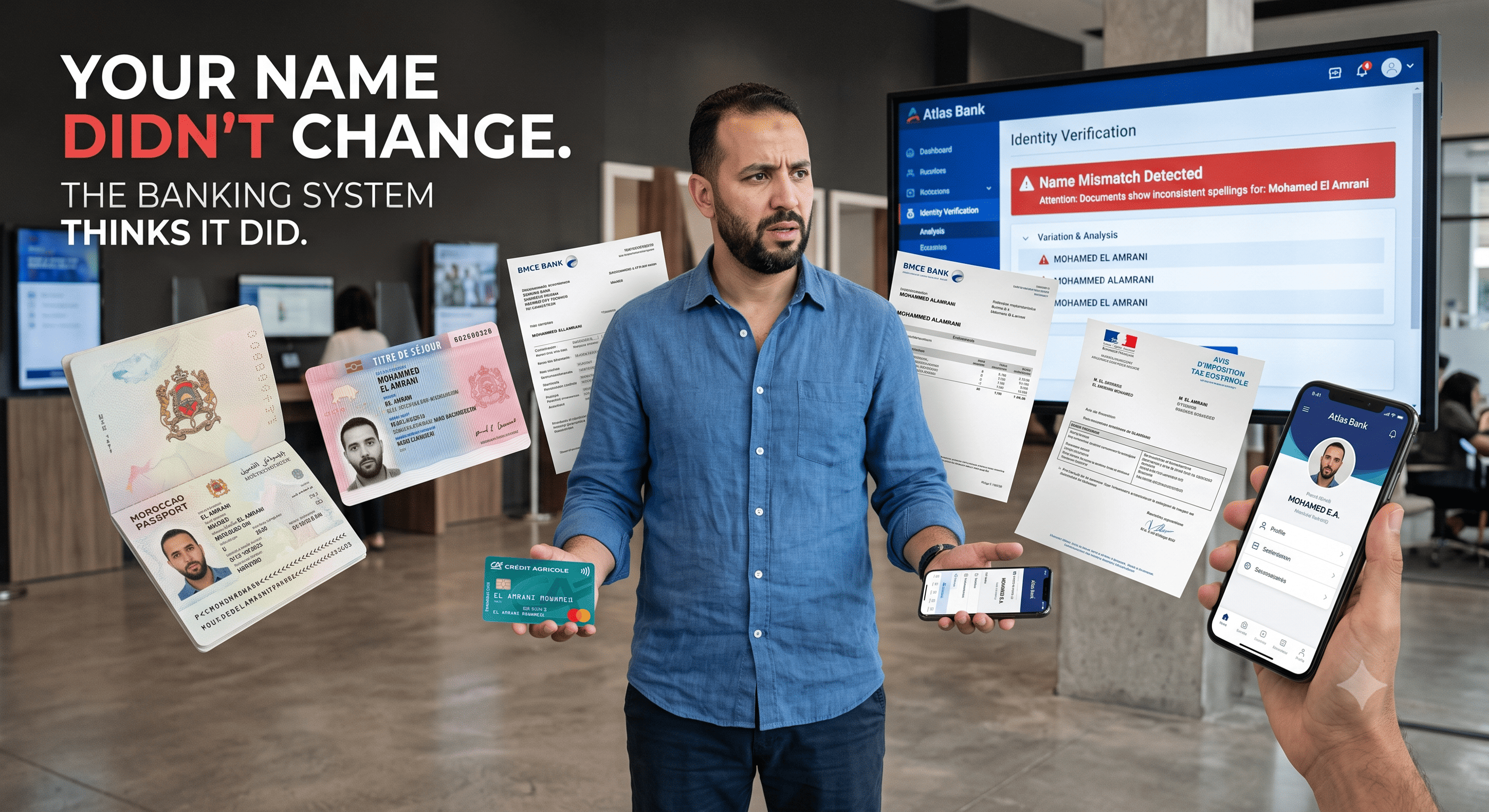
A name can be correct and still fail a banking check.
That is the problem many mobile customers face when their passport, residence permit, bank profile, tax document, and payment account show slightly different name formats. One system may expect a middle name. Another may remove accents. Another may split family names differently.
In international banking, these small differences can trigger big friction. A payment may be delayed. A bank may request extra documents. An account may fail identity verification even when the person is real and the documents are valid.
This affects expats, international students, diaspora customers, remote workers, and anyone using banking abroad. The issue is not only spelling. It is the gap between human identity and rigid banking systems.
You live internationally. Your bank should too.
Manage your money across countries without hidden fees, delays, or complexity.
Simplify your financial life abroad with Bankeaz.
Banking built for life between countries
Free early access
> Why do name formats create banking problems?
Name formats create banking problems because financial systems often expect names to fit fixed fields.
Many banking forms are built around first name, middle name, and last name. But names do not work the same way everywhere. Some people have several family names. Some have patronymics. Some use compound surnames. Some documents place the family name first. Some cultures do not use middle names at all.
A bank may read “Jean Paul” as two given names, while another system reads “Paul” as a middle name. A Spanish double surname may be shortened. An Arabic name may be transliterated differently. A name with accents may lose them in one system and keep them in another.
To the customer, the identity is consistent.
To the bank, the record may look mismatched.
That mismatch can affect account verification, payment screening, and customer due diligence.
> Why does KYC depend so much on names?
According to Swift ↗, KYC is a set of processes that allows banks and financial institutions to confirm the identity of the organisations and individuals they do business with.
That means a name is not just a label. It is part of how a bank connects a person to a passport, address, tax number, account history, sanctions screening, and transaction profile.
If the name on a passport does not match the name entered into a banking form, the system may not understand the difference. It may flag the account for manual review.
This is where bank verification becomes frustrating. The customer has not changed. The database has.
For people using banking for expats, a small name-format issue can become a repeated document problem.
> What kinds of name differences cause delays?
Several name differences can cause delays in cross-border banking.
Common examples include:
missing middle names;
reversed first and last names;
accents removed from names;
hyphenated names entered without hyphens;
married names and birth names used differently;
shortened names on payment accounts;
different transliterations from non-Latin alphabets;
compound surnames split incorrectly.
These differences often look minor. But banking systems rely on exact or near-exact matching.
A transfer recipient may be known as “Mohamed El Amrani” in one bank and “Mohammed Alamrani” in another. A French document may show “Élodie,” while an international form only accepts “Elodie.” A person may use one surname in daily life and two surnames on official documents.
The money may be legitimate. The name may be valid. The format may still break the process.
> How can this affect payments and account access?
Name-format problems can affect both payments and account access.
A bank may delay an international transfer if the sender name, recipient name, or account holder name does not align with the expected record. A compliance team may ask for supporting documents before releasing funds. In some cases, a payment may be returned.
Account access can also be affected. A customer may be asked to upload a passport again, provide a proof of identity, explain a name variation, or update personal details.
The practical consequences are real:
salary payments may be delayed;
rent or tuition transfers may miss deadlines;
family support may arrive late;
account opening may take longer;
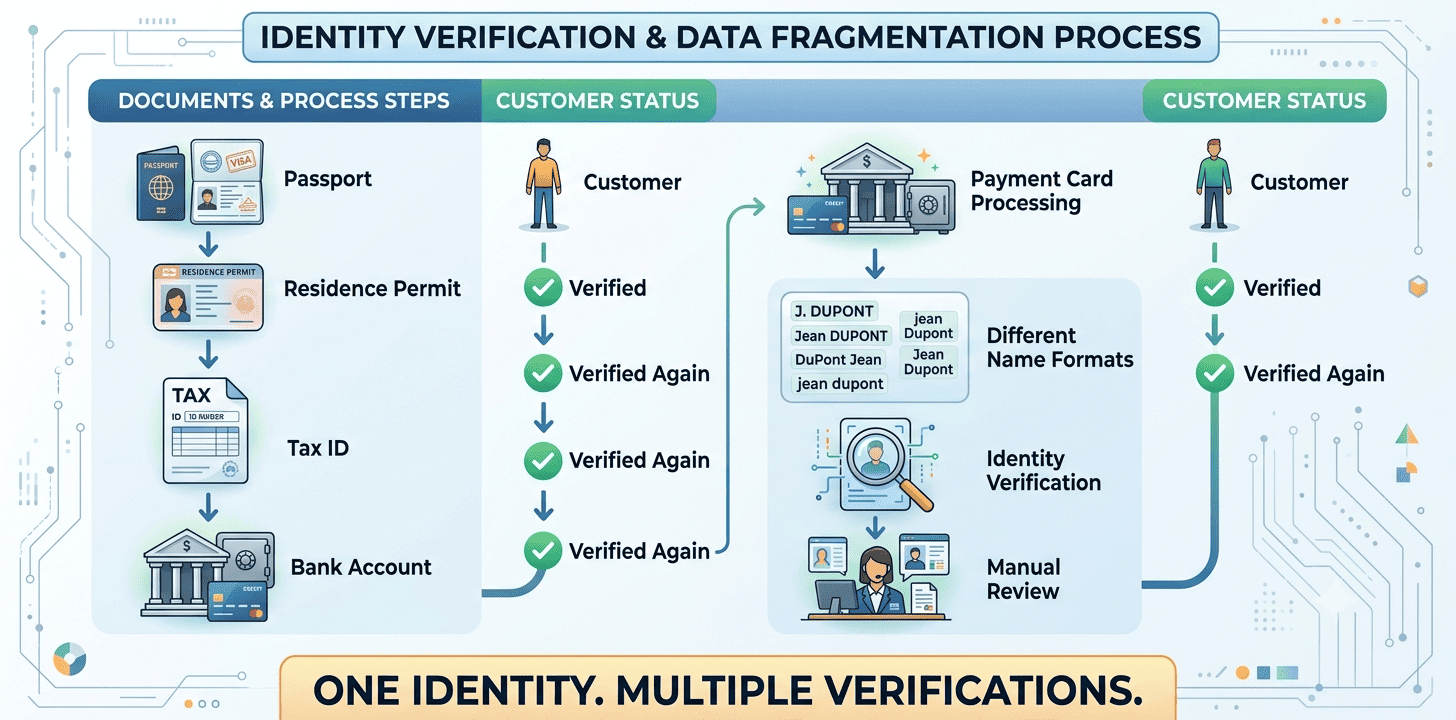
users may repeat verification across several providers.
This is why international banking needs better identity handling. A name should identify a person, not trap them inside one country’s format.
> Why is this harder for expats and diaspora customers?
Expats and diaspora customers often manage identity across several systems at once.
They may have a passport from one country, residence documents from another, tax records in a third, and bank accounts in multiple currencies. Each institution may store the same person slightly differently.
This creates a fragile financial profile. One spelling difference can follow the customer through payments, compliance checks, account openings, and mobile banking apps.
For diaspora customers, name-format issues can also affect family transfers. A relative’s name may appear differently on a local bank account, national ID, or mobile money wallet. When systems do not understand those differences, support payments can slow down.
That is why diaspora banking is not only about sending money. It is about making cross-country financial identity easier to recognize.
People move through the world with full names. Banking systems often ask them to shrink those names into boxes.
______________________________________________________________________________________________________________________________________________________
> How could name verification improve in the future?
Future systems may combine better digital identity, smarter transliteration rules, reusable proof of identity, and clearer customer-controlled profile updates. Instead of treating every spelling variation as a new risk, banks could understand when different formats refer to the same verified person.
This does not mean weakening compliance. Banks still need strong controls against fraud, sanctions breaches, and financial crime.
But better systems could reduce false friction. They could help legitimate customers prove identity once and keep that identity consistent across borders.
The future of financial mobility depends on more than faster apps. It depends on banking systems that understand names, documents, and people across countries.
You moved countries.
Your financial life shouldn't have to start from zero
International Transfers
> Conclusion
Name formats cause problems in international banking because banking systems often expect identity to follow local, fixed, and machine-readable patterns.
For mobile people, names may change format across passports, bank forms, tax documents, visas, and payment platforms. That can trigger KYC reviews, delayed transfers, repeated documents, and blocked access.
The future of banking will need more flexible identity infrastructure. A person’s name should not become a barrier to their money.
______________________________________________________________________________________________________________________________________________________
by BANKEAZ
On demand banking services for all


______________________________________________________________________________________________________________________________________________________
Learn more about Expat Banking

Global lives deserve simpler banking.




Download the BANKEAZ app for a 100% mobile banking experience. Available on iOS and Android - public testing by invitation.
Bankeaz is designed for people living between countries. Availability may vary depending on the user’s jurisdiction of residence.
The Bankeaz app is developed by Arcadia, a company currently being incorporated in Switzerland.
Bankeaz does not provide banking services in its own name. Financial services are provided by licensed and regulated partner institutions, in accordance with applicable laws and regulations.
Copyright © 2026 - Arcadia | Bankeaz - All rights reserved
Address
____________________






__________________________________________________________________________________________________________________________________________________


(- - -) - - - - - - - - - -
Zurich - CH
__________________________________________________________________________________________________________________________________________________
___________________________________________________________________________________________________________________________________________________
__________________________________________________________________________________________________________________________________________________
Learn
____________________