
Why Global Lives Still Break Banking
EXPAT BANKING
Blog > Expat Banking > Why Global Lives Still Break Banking
Why Global Lives Still Break Banking
EXPAT BANKING
BANKEAZ | Expats Team
7/16/2026 - 4 min read
Your life can move faster than your bank profile.
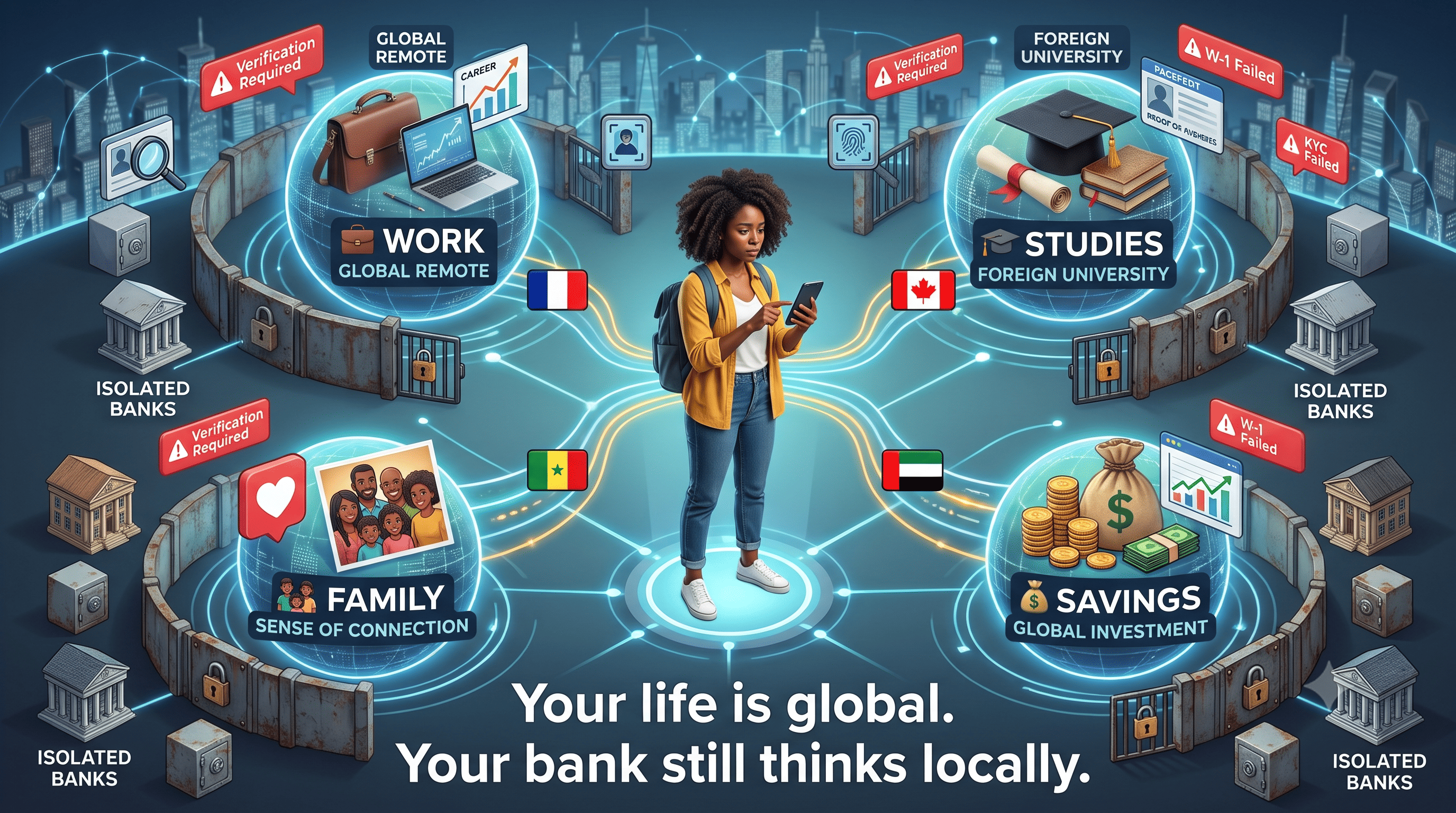
That is why international banking still creates friction for people who live, work, study, earn, or support family across borders. The problem is not that global customers are unusual. The problem is that many banking systems still treat them that way.
A person may have income in one country, residence in another, family obligations elsewhere, and savings spread across several accounts. Yet banks often assess that person through local rules, local documents, and local risk models.
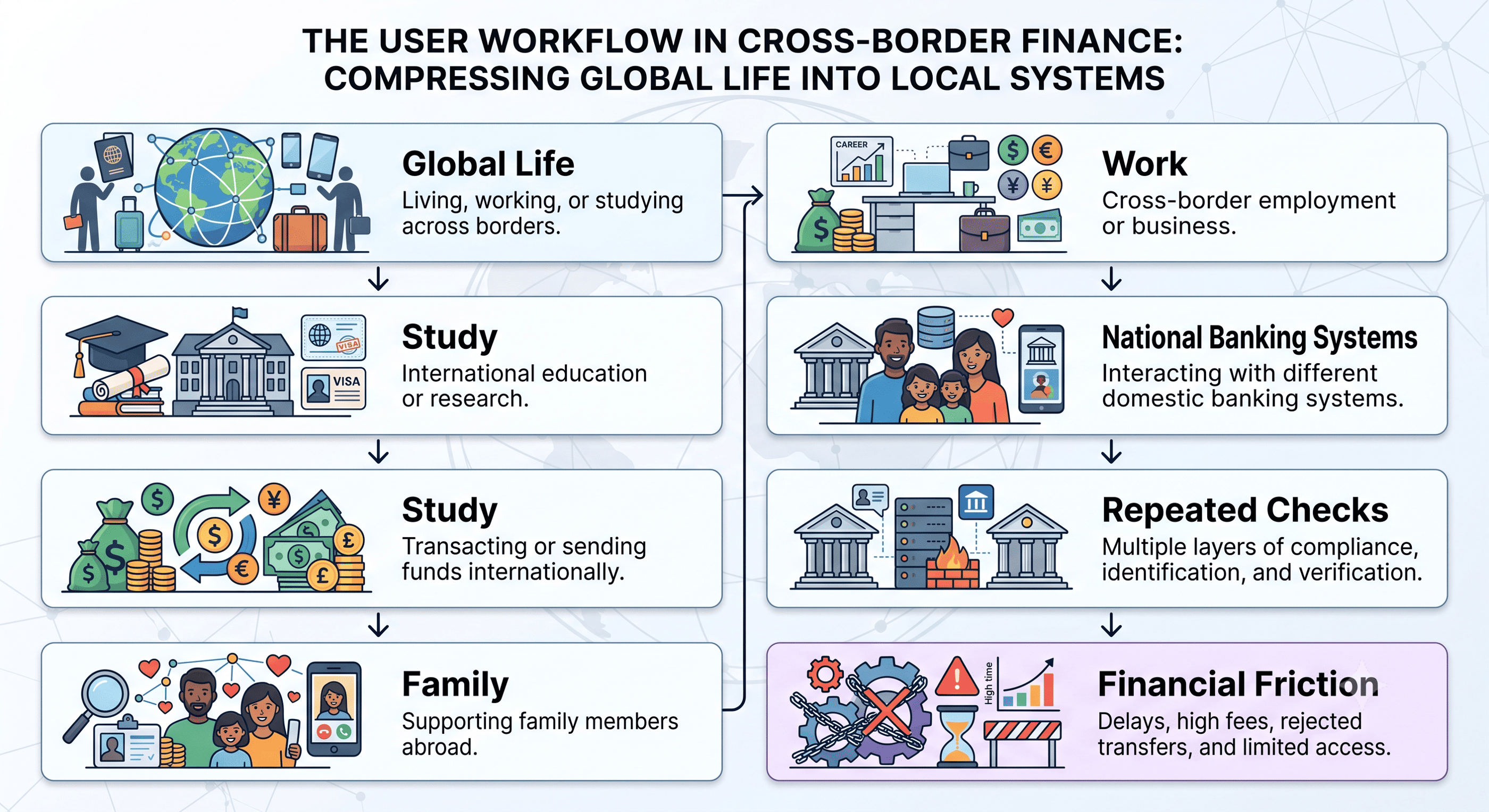
The answer is clear: banking struggles with global lives because financial systems remain national, while people’s lives are increasingly international. This creates delays, repeated checks, account restrictions, payment issues, and weaker financial continuity.
You live internationally. Your bank should too.
Manage your money across countries without hidden fees, delays, or complexity.
Simplify your financial life abroad with Bankeaz.
Banking built for life between countries
Free early access
> Why Do Banks Still Think Locally?
Most banks were built for domestic customers.
They expect one address, one tax residence, one main income source, and one familiar document set. That works for people whose financial lives stay inside one country.
It works less well for an expat who has just moved, a remote worker paid from abroad, an international student without local history, or a diaspora customer supporting family back home.
This is where cross-border banking becomes difficult. The customer may be legitimate, stable, and financially responsible. But the system reads their profile as incomplete because the information sits across borders.
A global life can look risky to a local system.
Learn more about international banking.
> What Breaks When Your Financial Life Crosses Borders?
The first problem is continuity.
A bank account may work perfectly before relocation. After a move, the bank may ask for updated documents, restrict certain services, or question activity that was normal before.
This can affect salary payments, rent, subscriptions, savings, and family support. It can also force people to manage several accounts in different countries, each with its own app, fees, rules, and verification requests.
For many people, banking abroad becomes less about convenience and more about survival. Access to money decides whether rent is paid, whether a transfer arrives, and whether life abroad feels manageable.
Moving country changes more than your address. It changes how the system interprets you.
> Why Are Identity Checks Repeated So Often?
Banks must follow compliance rules.
That includes KYC, identity checks, proof of address, anti-money laundering controls, and transaction monitoring. These rules protect the financial system. But they can become frustrating when every institution asks for similar information in a different way.
A customer may verify identity with one bank, then repeat the process with another provider, then submit fresh documents after moving again.
The issue is not only regulation. It is fragmentation.
Many systems cannot reuse verified information across institutions or countries. That makes identity verification repetitive, slow, and stressful for globally mobile people.
For expats, proof of address can be especially difficult. You may need a local bank account to rent a home, but you may need a rental contract to open the bank account.
Explore more about banking for expats.
> Why Do Payments Still Slow Down Across Borders?
Domestic payments have become faster in many countries.
Cross-border payments still often depend on multiple institutions, payment networks, currency conversions, and compliance checks. A transfer that looks simple to the sender may pass through several layers before reaching the recipient.
According to Bank for International Settlements ↗, domestic payments have become faster and cheaper, but cross-border payments still often run on slow rails with fragmented rules and high costs.
That matters for real life. A delayed payment can mean late rent, missed tuition, delayed family support, or cash-flow pressure for a small business.
This is why financial mobility is not only about moving money. It is about whether people can rely on their money when life crosses borders.
> How Does Fragmented Banking Affect Diaspora Families?
Global lives often include family responsibilities.
A person may live in France, earn in euros, support relatives in Senegal, save in another currency, and keep financial ties to a home country. That is not unusual. It is normal for millions of diaspora families.
But banking systems often treat these relationships as separate problems: one account for local life, another provider for transfers, another tool for currency conversion, and another process for verification.
This fragmentation creates hidden costs in time, attention, and control. People must track fees, exchange rates, transfer delays, and account access across several systems.
For diaspora communities, diaspora banking is not just about sending money. It is about keeping financial relationships alive across distance.
______________________________________________________________________________________________________________________________________________________
> What Needs to Change in the Future?
The future of banking will depend on portability.
That does not mean removing regulation. It means making regulated banking work better for mobile lives.
Better systems could include reusable verification, more interoperable payment networks, stronger digital identity, connected financial data, and clearer cross-border compliance processes.
The goal is simple: customers should not become financially invisible every time they move.
Future expat banking must understand that a person’s financial identity can be international. Income, residence, documents, and family obligations may not sit neatly in one country. Banking systems will need to recognize that reality without making users start from zero each time.
You moved countries.
Your financial life shouldn't have to start from zero
International Transfers
> Conclusion
Banking still struggles with global lives because the system was built around national assumptions.
People now move, work, study, earn, and support families across borders. But many banks still rely on local documents, local infrastructure, and local risk models.
The future of international banking will depend on continuity: portable identity, clearer payments, reusable verification, and financial access that follows people instead of trapping them inside one country.
Global lives are already here. Banking is still catching up.
______________________________________________________________________________________________________________________________________________________
by BANKEAZ
On demand banking services for all


______________________________________________________________________________________________________________________________________________________
Learn more about Expat Banking

Global lives deserve simpler banking.





Download the BANKEAZ app for a 100% mobile banking experience. Available on iOS and Android - public testing by invitation.
Bankeaz is designed for people living between countries. Availability may vary depending on the user’s jurisdiction of residence.
The Bankeaz app is developed by Arcadia, a company currently being incorporated in Switzerland.
Bankeaz does not provide banking services in its own name. Financial services are provided by licensed and regulated partner institutions, in accordance with applicable laws and regulations.
Copyright © 2026 - Arcadia | Bankeaz - All rights reserved
Address
____________________






__________________________________________________________________________________________________________________________________________________


(- - -) - - - - - - - - - -
Zurich - CH
__________________________________________________________________________________________________________________________________________________
___________________________________________________________________________________________________________________________________________________
__________________________________________________________________________________________________________________________________________________
Learn
____________________