
How to Track the Identity Documents Linked to Your Bank Accounts
EXPAT BANKING
Blog > Expat Banking > How to Track the Identity Documents Linked to Your Bank Accounts
How to Track the Identity Documents Linked to Your Bank Accounts
EXPAT BANKING
BANKEAZ | Expats Team
14/10/2026 - 4 min read


You renewed your passport six months ago. Your main bank accepted the replacement, but a second bank still displays an older document. A third provider does not show which identification it holds.
All three accounts belong to you, yet the records behind them may be different.
This becomes a practical issue when you need identity verification, request a new service, recover account access, or respond to an unexpected document review.
Tracking the bank documents linked to each account helps you distinguish between the identification you currently possess and the evidence each institution may still have on record.
The objective is not to collect unnecessary copies of sensitive documents. It is to create a reliable overview of document status, update requests, and confirmations.
Here is how to build that overview and maintain it across countries.
Build a complete list of the financial institutions that may hold your identity records.
Start With the Account Map


> Create an Identity-Document Register for Each Bank Account
Start by listing the institutions with which you maintain a financial relationship.
Include your everyday bank accounts, foreign accounts, savings accounts, and payment providers where relevant. If several accounts belong to the same institution, check whether they share one customer identity profile or require separate records.
Your register should describe each relationship without becoming a second banking database.
Record the institution name and account nickname; country and type of financial relationship; document type last submitted, if known; whether the institution shows the document as current; date of the last confirmed account verification; and next action and its status.
Do not assume that an account opened with your passport necessarily still references that passport. A bank may have updated its records during a later review.
For example, you might maintain a French account verified with a national identity card, a Senegalese account opened using a passport, and a British account verified through an electronic process.
The important distinction is between known, assumed, and unconfirmed information.
If your bank does not display its identification records, write “Not disclosed” and ask through an official support channel what information can be confirmed or updated.
Avoid entering full account numbers, complete passport numbers, passwords, or authentication codes into the register. An account nickname and a limited document reference are usually enough for personal tracking.
Practical result: You now know which institution needs attention, without repeatedly searching through old emails and document folders.
Distinguish the identity document you hold today from the credential recorded by each bank.
Separate Document Ownership From Bank Records


> Record Document Changes Without Losing Their History
An identity document has a lifecycle. It is issued, used, renewed, replaced, or cancelled. Your banking relationship may continue throughout that lifecycle.
For each document used for proof of identity, track its type, issuing country, expiry date, replacement date and any bank updates associated with it.
A simple document reference can help: PASSPORT-A — Replaced September 2026. You do not need to reproduce its complete identification number.
When a document changes, preserve the distinction between the previous and replacement credentials. Do not simply overwrite the old entry in your tracking sheet.
Suppose you renew your passport in September. Bank A accepts the replacement in October. Bank B has not requested an update. Bank C asks you to complete additional KYC checks. Your register should retain three different statuses.
It is also important to distinguish an expired credential from a completed verification.
An institution may have policies concerning historical identification records, accepted identification types, and the timing of new checks. You should not assume an expired document automatically makes an account unusable, nor that an active account proves all records are current.
When renewal is approaching, check the institution’s instructions. Some banks allow proactive uploads; others require customers to wait for a secure request or use a particular profile-update workflow.
If a document has been lost or stolen, follow the issuing authority’s reporting process and the bank’s security instructions rather than treating the event as ordinary expiry.
Your register should reflect both the document event and the institution’s response.
Practical result: You preserve a clear history of which credential was used and which banks still require action.


Find out whether your bank provides a visible identity-document status or an official update workflow.
Verify What Each Bank Actually Holds


> Confirm Which Identity Information Is on File
Your register becomes more useful when it reflects verified information rather than memory.
Begin with your bank’s authenticated website or application. Look for sections such as Personal Details, Identification, Customer Profile, Verification, or Document Management.
The available information varies. A bank might display the document type and expiry date, while another may show only that identity verification was completed.
Some providers do not expose the underlying identification details to customers at all.
If you cannot see the relevant record, contact the institution through its official channel and ask a precise question: “Can you confirm whether my identity-document record is current, and whether I need to submit my renewed passport?”
A bank may be unable to disclose every detail through chat or telephone. That does not mean the document is necessarily missing.
When a bank responds, record the confirmation date, the channel used, and the next step.
Use three separate labels: Confirmed — the institution has verified or acknowledged the relevant update; Pending — you have submitted a request, but the process is not complete; Unknown — you cannot establish what the institution currently records.
Do not mark a document as confirmed merely because you uploaded it successfully. An upload receipt confirms submission, not necessarily acceptance.
For cross-border banking, this distinction matters because two banks may have different document requirements, review procedures, and response times.
Practical result: Your personal register becomes a record of verified statuses rather than unsupported assumptions.
Keep a minimal audit trail of submission dates, acknowledgments and outstanding actions.
Keep an Evidence Trail


> Track Submissions, Responses, and Outstanding Updates
Updating your bank documents can involve more than one interaction.
You may submit a replacement passport, receive an acknowledgment, complete an additional security check, and later receive confirmation that your record has been updated. Capture the main events in an update log.
The log should contain enough information to reconstruct what happened without storing unnecessary confidential data.
Keep any reference number provided by the institution, preferably in a secure record. Avoid putting complete identity numbers or document scans in an ordinary shared spreadsheet.
If a bank requests a second submission, determine whether it is asking for a different document, better image quality, a verification step, or clarification of the information already provided. Do not automatically upload the same material repeatedly.
Use a bank’s authenticated document-submission channel whenever available. Avoid sending passport images through unsolicited links, public messaging services, or unverified email addresses.
If you store supporting documents yourself, use encrypted storage with strong authentication and restricted access. Keep them only for as long as you have a legitimate need, and follow applicable requirements.
A personal register does not replace the institution’s official customer record or its compliance obligations.
Practical result: You can identify incomplete updates and respond with the correct history rather than starting each conversation again.
Review your identity-document register when a credential changes or a financial relationship requires attention.
Make Reviews Event-Driven


> Build a Review Schedule and Resolve Exceptions
A useful tracking system should remain manageable even if you maintain accounts in several countries.
Review the register periodically, for example every six months, and whenever a significant change occurs.
Triggers may include passport renewal, replacement of a national identity card, relocation, a change in residence permission, an account reactivation, or a bank’s formal request for updated information.
Not every event requires the same response at every institution. Check the relevant account conditions before submitting new material.
Give particular attention to exceptions.
An exception is anything preventing you from clearly identifying the status of a bank’s record. Examples include an unconfirmed upload, an outdated document reference, an unresolved verification request, or an institution that cannot provide confirmation through its usual support process.
Assign each exception an owner and a next action. For a personal register, the owner will normally be you, but the action may depend on a bank’s response or an issuing authority.
You can also establish a simple priority order: urgent security or access issues first, formal requests with deadlines next, and routine uncertainty later.
A reminder for a document’s expiry date does not guarantee that an institution will accept a replacement immediately. It simply gives you time to determine the correct process.
Review the security of the register itself. Remove obsolete unnecessary copies, check who can access it, and make sure its backup is protected.
The aim is financial mobility supported by reliable personal administration, not a permanent archive containing every historical document.
Practical result: Your identity-document tracking remains accurate, proportionate, and actionable as your international financial relationships evolve.
Apply the same tracking principles each time an identity document or banking relationship changes.
Turn Records Into a Repeatable Process


______________________________________________________________________________________________________________________________________________________
> Key Takeaways
✓ List every institution that maintains an identity record associated with your accounts.
✓ Distinguish current identification documents from documents previously submitted.
✓ Record each document’s expiry or replacement date without exposing sensitive identification numbers.
✓ Check the institution’s official records rather than assuming an update occurred.
✓ Separate document submission from acceptance and completed verification.
✓ Maintain a secure record of update requests, references, and confirmations.
✓ Review outstanding cases after document changes, relocations, or bank requests.
✓ Protect your register and avoid retaining unnecessary copies of sensitive documents.
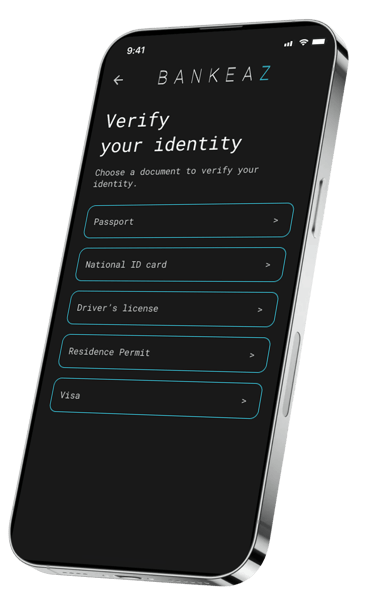
Bankeaz is designed for multi-country financial lives.
Identity verification follows each regulated institution’s requirements.
A personal document register helps prepare for verification processes.
Identity Records Across Countries
> Conclusion
Tracking identity documents across bank accounts is primarily an exercise in maintaining accurate records.
Start with an institution-by-institution register. Record which identification was used, distinguish current documents from previous credentials, verify the status with each bank, and keep a secure record of outstanding requests.
A lightweight review routine can help prevent uncertainty when passports expire, residence circumstances change, or institutions initiate new checks.
These steps make your own records clearer and can help you respond more precisely to future verification requests.
However, personal organization cannot make fragmented banking systems interoperable. Institutions continue to apply separate policies, maintain independent customer records, and operate under different national requirements.
Better document tracking reduces uncertainty on your side, even when the underlying international identity infrastructure remains divided across borders.
> Related reads
Why a New Passport Can Trigger Identity Verification Again
Discover why renewing your passport can trigger a new identity verification process with your bank, even when your personal circumstances have not changed.
Why Old Bank Records Trigger New Verification
Understand why outdated or inconsistent banking records can trigger additional verification checks and complicate your banking procedures.
How to Keep Your Financial Profile Consistent
Learn how to keep your personal, banking, and financial information consistent across institutions to make verification processes easier.
How to Prepare Foreign-Issued Documents for Bank Verification
Learn how to prepare foreign-issued documents by checking their validity, format, and translation or authentication requirements before submitting them to your bank.
______________________________________________________________________________________________________________________________________________________
by BANKEAZ
On demand banking services for all


______________________________________________________________________________________________________________________________________________________
Learn more about Expat Banking

Global lives deserve simpler banking.






Download the BANKEAZ app for a 100% mobile banking experience. Available on iOS and Android - public testing by invitation.
Bankeaz is designed for people living between countries. Availability may vary depending on the user’s jurisdiction of residence.
The Bankeaz app is developed by Arcadia, a company currently being incorporated in Switzerland.
Bankeaz does not provide banking services in its own name. Financial services are provided by licensed and regulated partner institutions, in accordance with applicable laws and regulations.
Copyright © 2026 - Arcadia | Bankeaz - All rights reserved
Address
____________________






__________________________________________________________________________________________________________________________________________________


(- - -) - - - - - - - - - -
Zurich - CH
__________________________________________________________________________________________________________________________________________________
___________________________________________________________________________________________________________________________________________________
__________________________________________________________________________________________________________________________________________________
Learn
____________________