
How to Stop Losing Money on Exchange Rates
EXPAT BANKING
Blog > Expat Banking > How to Stop Losing Money on Exchange Ratest
How to Stop Losing Money on Exchange Rates
EXPAT BANKING
BANKEAZ | Expats Team
7/15/2026 - 4 min read
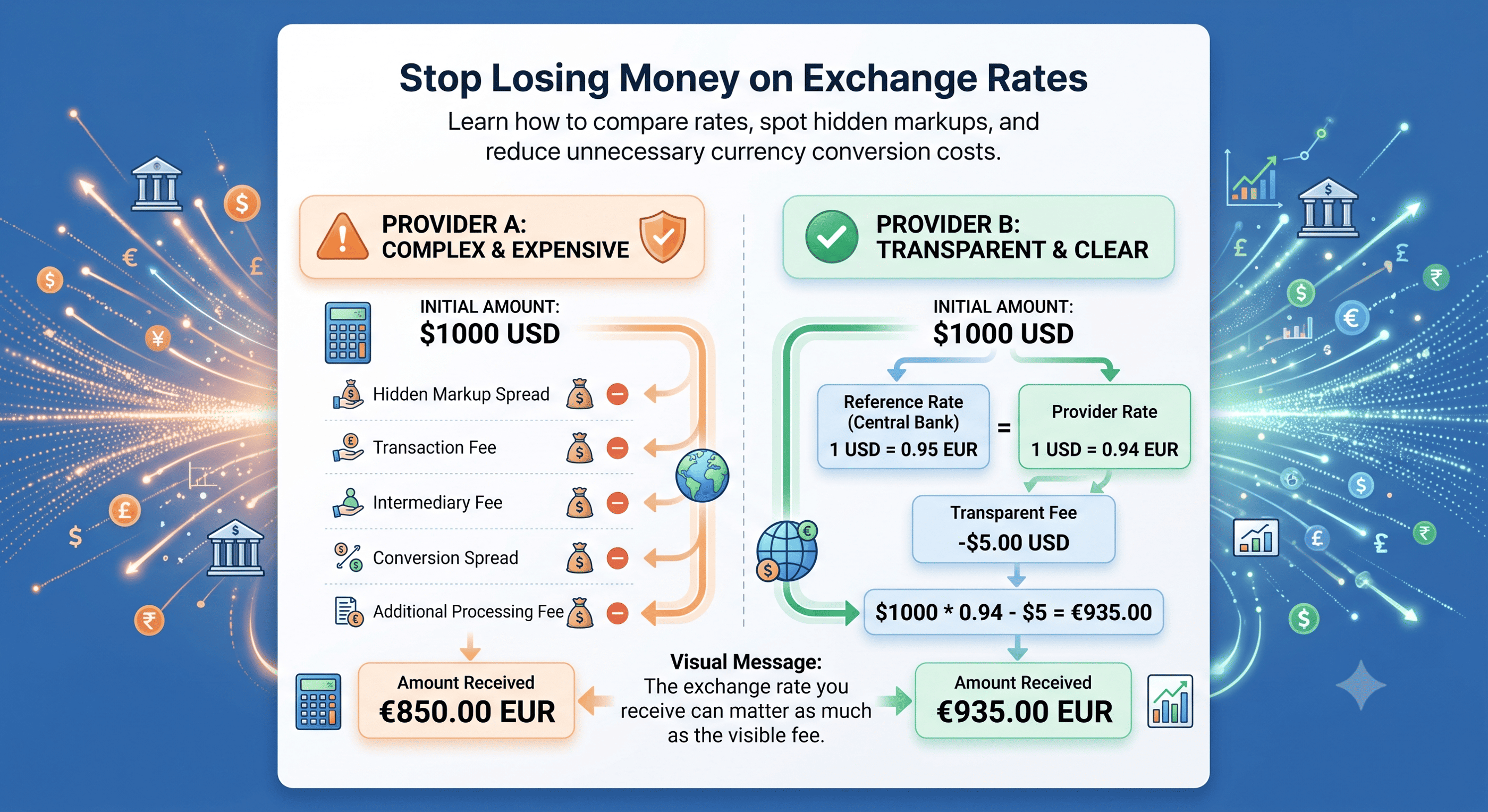
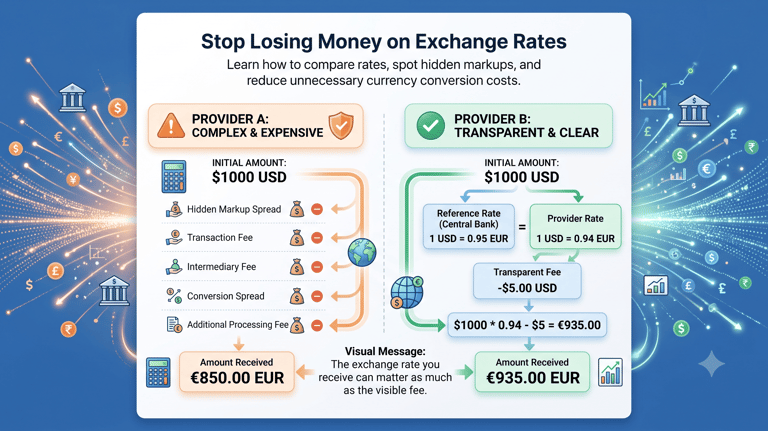
If you live, work, study, travel, or manage money across countries, currency conversion may be a regular part of your financial life.
The problem is that the cost of exchanging money is not always shown as a simple fee. A bank, card issuer, ATM, transfer provider, or payment processor may apply its own exchange rate. That rate can include a markup compared with a commonly used reference rate.
As a result, a transaction advertised as having a low fee—or even no fee—may still cost more than expected.
Understanding how exchange rates work can help you compare options more effectively, avoid unnecessary conversions, and keep more value when moving or spending money across currencies.
Before converting money, compare the offered rate with an independent reference rate. The difference can reveal part of the true cost of the transaction.
What Is the Real Exchange Rate?
> Compare the Exchange Rate, Not Just the Fee
One of the most important steps is to look beyond the advertised transaction fee.
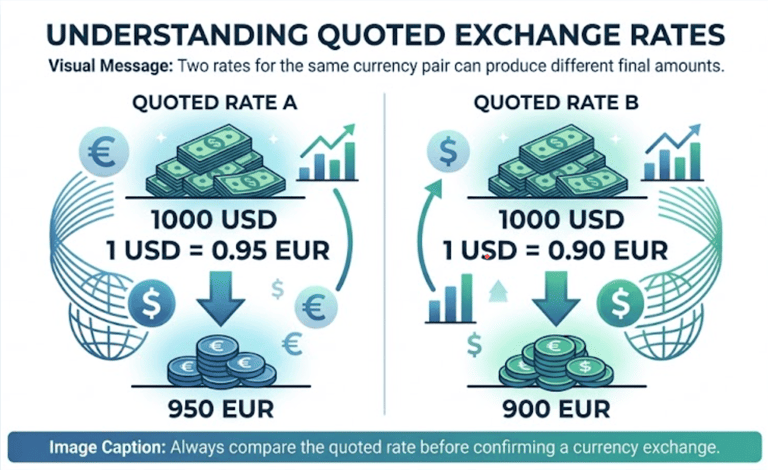
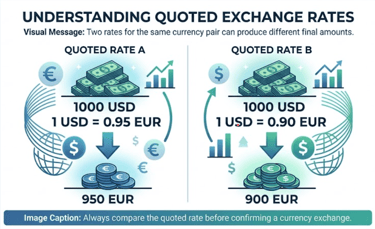
Suppose you want to exchange €1,000 into another currency. One provider may charge a visible €5 fee but offer a relatively competitive exchange rate. Another may advertise zero fees but use a less favorable rate.
The second option could ultimately leave you with less money.
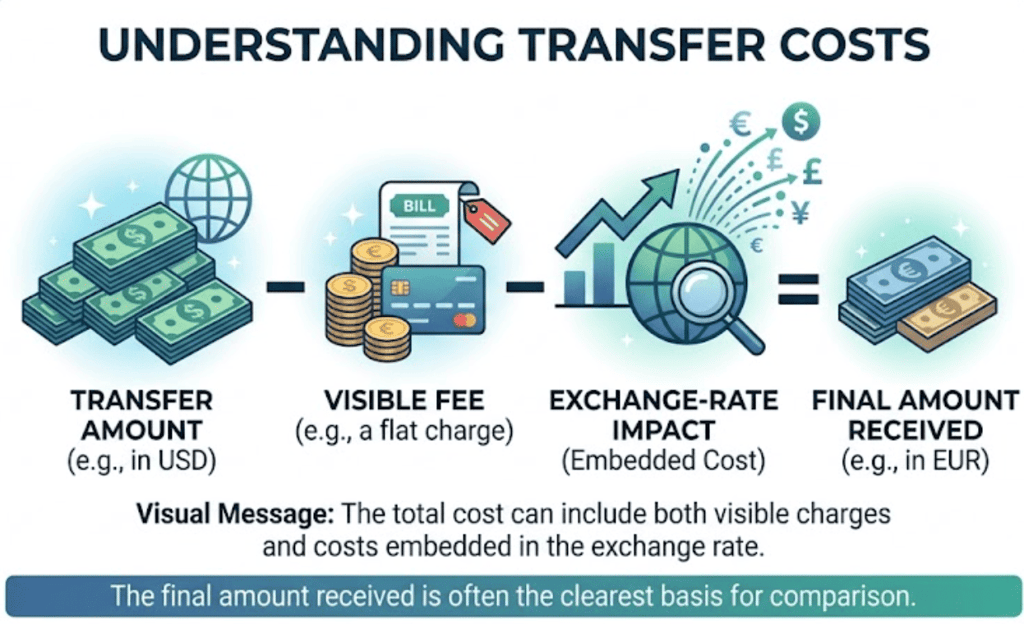
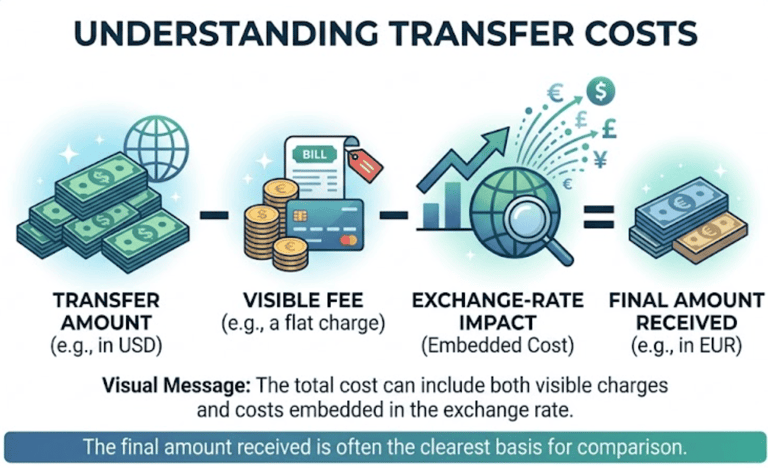
Before completing a conversion, check three figures: the current reference rate for the currency pair, the exchange rate offered by the provider, and the final amount the recipient or account will actually receive.
The difference between the reference rate and the provider’s rate is often called an exchange-rate markup or spread. This difference may be small on a single transaction, but repeated conversions can make it significant over time.
For example, a 2% difference on a €100 conversion represents €2. On €10,000, the same percentage represents €200.
When comparing providers, focus on the total outcome rather than one advertised number.
The exchange rate itself may contain a markup. Compare the amount sent with the amount ultimately received.
A Zero-Fee Transfer Is Not Always Free
> Avoid Unnecessary Currency Conversions
Every additional currency conversion creates another opportunity for costs to appear.
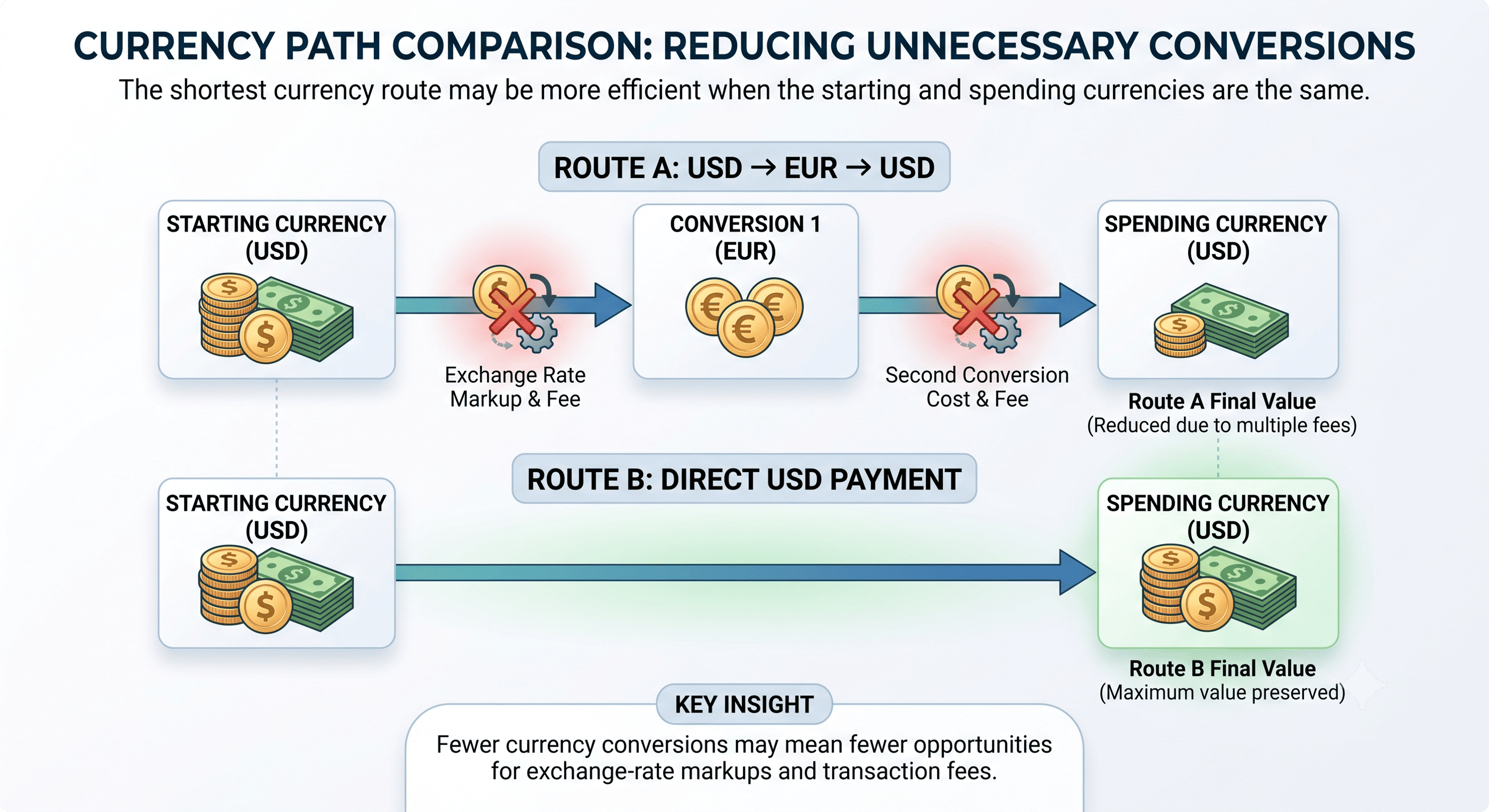
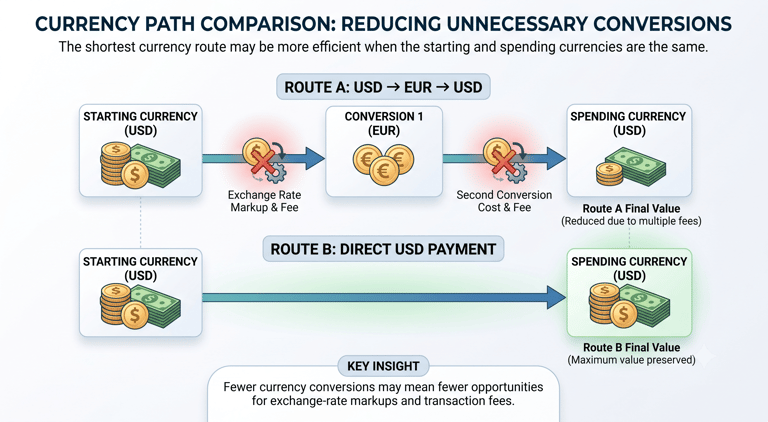
For example, imagine that you receive income in US dollars, automatically convert it into euros, and later need to make a payment in US dollars. Your money may be converted twice: once from USD to EUR and again from EUR to USD.
Each conversion can involve a spread, fee, or both.
When possible, consider keeping funds in the currency in which you expect to spend or transfer them. This can be particularly relevant for remote workers paid by foreign clients, expatriates managing obligations in several countries, international students receiving family support, and people with recurring expenses abroad.
Before accepting automatic conversion, ask whether the money needs to be converted immediately.
You may be able to reduce unnecessary currency exchanges by matching income and expenses in the same currency, planning recurring payments by currency, and checking whether your financial provider supports holding more than one currency.
The objective is not to avoid all currency conversion. For internationally mobile people, that may be unrealistic.
The goal is to avoid conversions that serve no practical purpose.
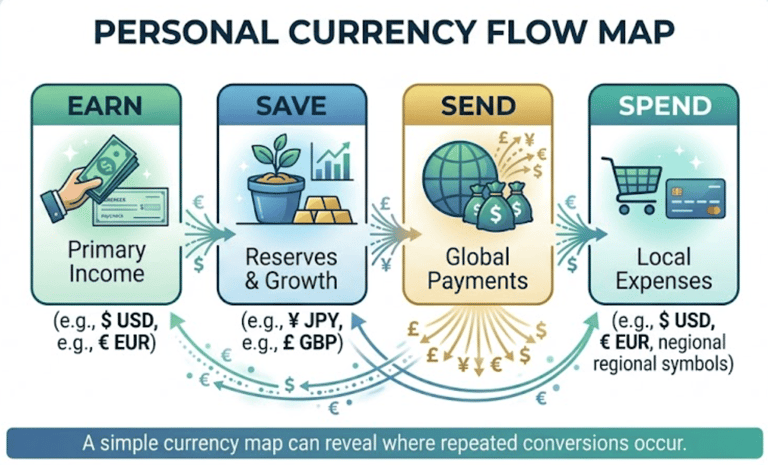
List the currencies you earn, save, send, and spend. This simple exercise can reveal unnecessary conversion loops.
Which Currencies Do You Actually Use?
> Choose the Right Currency When Paying by Card or Using an ATM
When paying abroad, a card terminal or ATM may ask whether you want to pay in your home currency or the local currency.
This choice matters.
If you select your home currency, the merchant or ATM operator may perform the conversion through a process commonly known as dynamic currency conversion. The exchange rate used may be less favorable than the rate applied by your card network or financial provider.
In many situations, choosing the local currency allows your own card provider or payment network to handle the conversion instead. However, the final cost still depends on your card’s foreign transaction fees and exchange-rate policy.
Before traveling, check how your card handles foreign-currency transactions. Look for foreign transaction fees, ATM withdrawal fees, exchange-rate markups, and additional charges from local ATM operators.
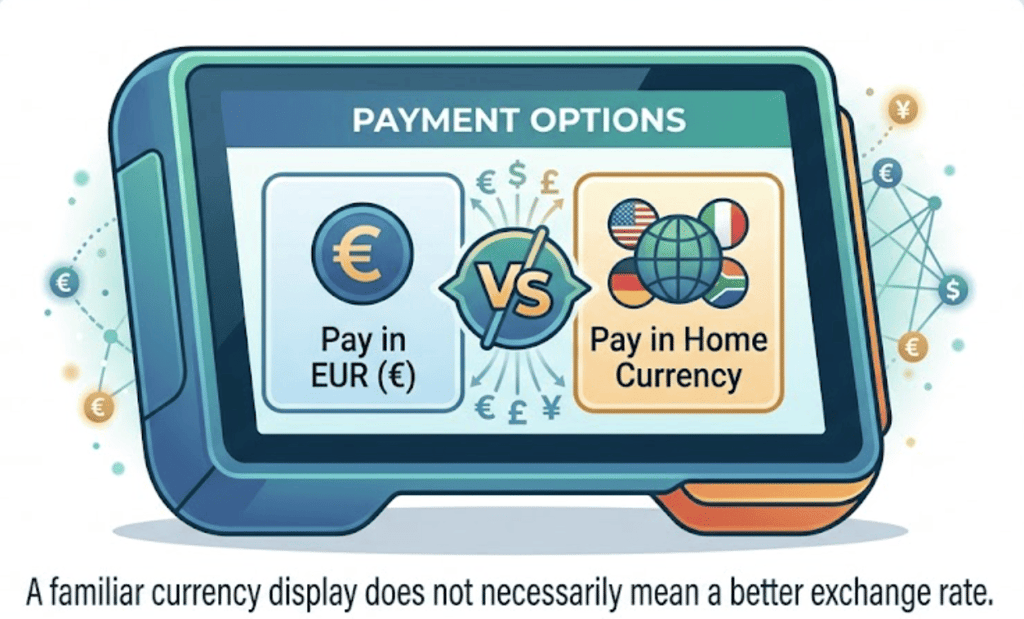
At the point of payment, read the screen carefully. Do not assume that seeing a familiar currency means receiving a better deal.
The most useful question is simple: Who is performing the currency conversion, and at what rate?
When a terminal or ATM offers a conversion, check who sets the rate before accepting.
Local Currency or Home Currency?
> Plan Large Transfers Instead of Converting Automatically
Timing currency markets perfectly is extremely difficult. Exchange rates move in response to interest rates, inflation, economic data, political events, market expectations, and many other factors.
For most individuals, trying to predict the perfect moment to exchange money can create more uncertainty rather than better results.
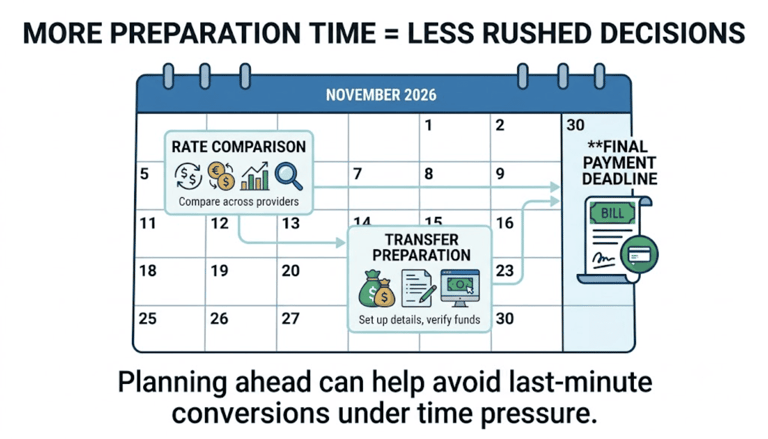
A more practical approach is to plan ahead.
If you know you will need a large amount of foreign currency for tuition, relocation, property expenses, family support, or another major payment, start monitoring the currency pair before the deadline.
This gives you time to compare providers and understand normal fluctuations rather than being forced to accept whatever rate is available on the final day.
For some large planned expenses, splitting a conversion into several smaller transactions may reduce the risk of exchanging the entire amount at one particularly unfavorable moment. However, this does not guarantee a better overall result, and additional transaction fees should always be considered.
The priority should be preparation, not speculation.
Know your payment deadline, required currency, target amount, provider fees, transfer limits, and expected processing time.
Early preparation gives you more time to compare rates, providers, limits, and processing times.
Do Not Leave Currency Transfers Until the Last Minute
> Track the Total Cost of Your Cross-Border Money Habits
Many people compare rates for one large transfer but ignore smaller recurring transactions.
Yet regular card purchases, ATM withdrawals, subscriptions, salary conversions, remittances, and international transfers can create cumulative costs.
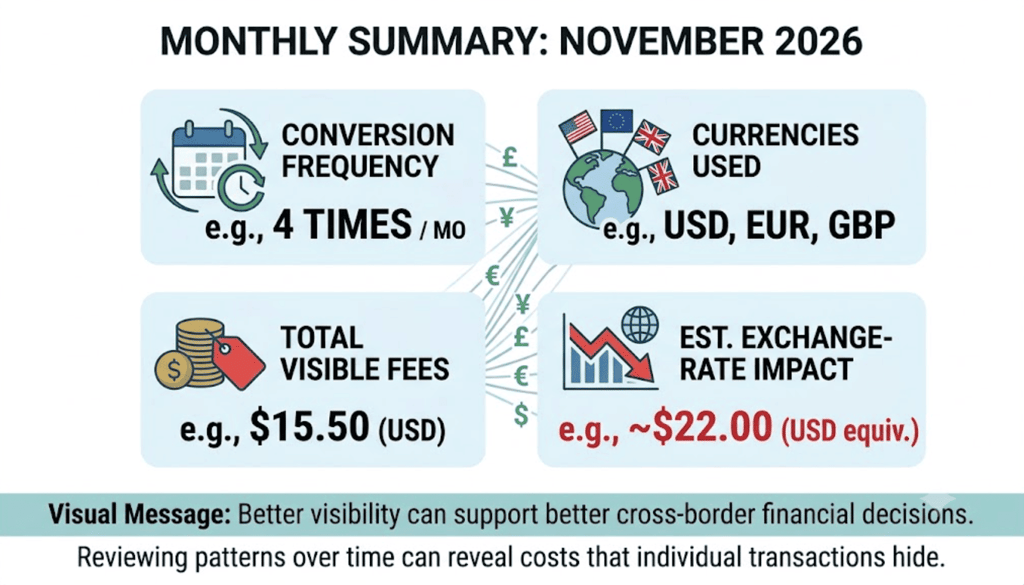
Review your cross-border activity over several months. Identify how often you convert money, which currencies you use most frequently, what visible fees you pay, whether exchange-rate markups apply, and where duplicate conversions occur.
A simple monthly review can reveal patterns.
For example, you may discover that you repeatedly receive money in one currency, convert it automatically, and then spend part of it in the original currency. Or you may find that frequent small ATM withdrawals create more charges than fewer planned withdrawals.
The right approach depends on your circumstances, currencies, countries, financial providers, and payment needs.
What matters is visibility. Costs that are difficult to see are also difficult to manage.
Review several months of international transactions to identify repeated conversions, markups, and avoidable fees.
How Much Are Currency Conversions Costing You?
______________________________________________________________________________________________________________________________________________________
> Key Takeaways
✓ Compare the offered exchange rate with an independent reference rate before converting money.
✓ Do not judge a transfer only by its advertised fee.
✓ Check the final amount received after all fees and exchange-rate differences.
✓ Avoid unnecessary conversion loops between currencies.
✓ Consider whether you need to convert funds immediately.
✓ When paying abroad, check who performs the currency conversion.
✓ Review foreign transaction and ATM fees before traveling.
✓ Plan large international payments before the deadline.
✓ Avoid relying on attempts to predict the perfect exchange-rate moment.
✓ Review your recurring cross-border activity to identify cumulative costs.
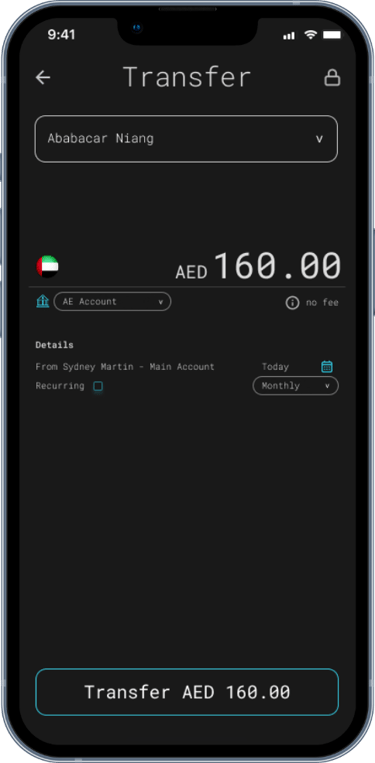
Compare the sending and receiving currencies.
Check the quoted exchange rate and expected amount.
Understand where currency conversion occurs before confirming.
See Currency Choices in the Context of a Transfer
> Conclusion
Reducing losses from exchange rates starts with understanding the full cost of currency conversion.
Compare the offered rate rather than focusing only on visible fees. Avoid unnecessary conversions. Pay attention to the currency selected at card terminals and ATMs. Prepare large transfers in advance, and review recurring cross-border activity to identify patterns that may be costing you money.
These actions can help reduce part of the friction and make international money decisions more informed.
However, many international financial processes still depend on fragmented systems, multiple intermediaries, separate accounts, and country-specific infrastructures. For internationally mobile people, this complexity continues to make managing, moving, and spending money across borders more difficult than it needs to be.
> Related reads
How to Check the Real Cost of an International Money Transfer
You saw the fee. Did you see the real cost?
______________________________________________________________________________________________________________________________________________________
by BANKEAZ
On demand banking services for all


______________________________________________________________________________________________________________________________________________________
Learn more about Expat Banking

Global lives deserve simpler banking.




Download the BANKEAZ app for a 100% mobile banking experience. Available on iOS and Android - public testing by invitation.
Bankeaz is designed for people living between countries. Availability may vary depending on the user’s jurisdiction of residence.
The Bankeaz app is developed by Arcadia, a company currently being incorporated in Switzerland.
Bankeaz does not provide banking services in its own name. Financial services are provided by licensed and regulated partner institutions, in accordance with applicable laws and regulations.
Copyright © 2026 - Arcadia | Bankeaz - All rights reserved
Address
____________________






__________________________________________________________________________________________________________________________________________________


(- - -) - - - - - - - - - -
Zurich - CH
__________________________________________________________________________________________________________________________________________________
___________________________________________________________________________________________________________________________________________________
__________________________________________________________________________________________________________________________________________________
Learn
____________________